
Uganda’s rapid urban transformation is reshaping cities and communities across the country. As new buildings rise and urban centres expand, an important national conversation is emerging: how can Uganda modernize without losing its cultural and architectural identity?
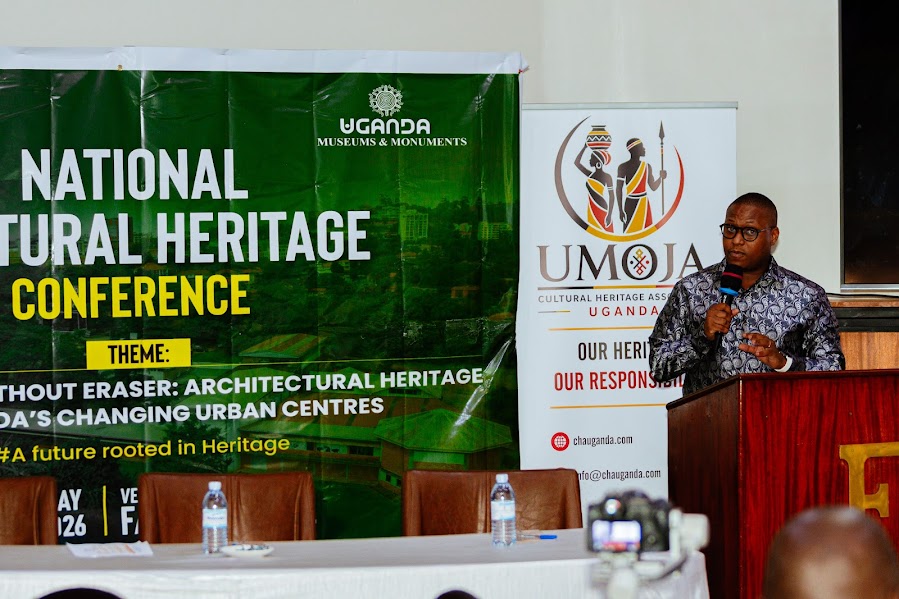
This critical issue took centre stage during the 3rd National Cultural Heritage Conference 2026, organized by Umoja Cultural and Heritage Association Uganda (CHAU) in partnership with the Ministry of Tourism, Wildlife and Antiquities under the Department of Museums and Monuments. Held on 5th May 2026 at Fairway Hotel in Kampala, the conference was themed: “Urbanisation without Erasure: Architectural Heritage in Uganda’s Changing Urban Centres.”
The event brought together government officials, legal experts, architects, cultural leaders, urban planners, and heritage advocates to discuss the future of Uganda’s built heritage in the face of growing urbanization.
A Call for Heritage-First Urban Development
The conference’s chief guest, Martin Mugarra Bahinduka, delivered a strong message on the urgent need to protect Uganda’s historical and cultural landmarks.
He warned that the continued demolition and neglect of heritage sites threaten not only Uganda’s history, but also its tourism competitiveness and national identity. According to the Minister, urban development and heritage preservation should not be viewed as opposing forces.
He urged government institutions, private developers, and local authorities to adopt a “heritage-first” approach to urban planning and development.
“The future of Uganda’s cities depends not only on what we build, but on what we choose to preserve. Let us build cities that tell our stories, not erase them,” the Minister emphasized.
He also highlighted the connection between heritage conservation and sustainable development, noting that Uganda’s efforts align with UNESCO’s Historic Urban Landscape framework and Sustainable Development Goal 11, which focuses on sustainable cities and communities.
Rethinking Urban Development Through Heritage Law
The keynote address was delivered by Dr. C.K. Kakooza, a respected property law expert who challenged Ugandans to rethink land ownership and urban development through a heritage-sensitive legal perspective.
Dr. Kakooza cautioned that uncontrolled commercial expansion risks permanently altering Uganda’s historical and cultural character.
“Cities are more than economic spaces; they are repositories of memory, identity and belonging. Once heritage is erased through careless redevelopment, it cannot be recreated,” he stated.
He called for stronger enforcement of conservation laws, improved heritage-sensitive land governance, and greater public awareness regarding the legal and cultural importance of historic buildings.
He further noted that protecting architectural heritage does not hinder development. Instead, he explained that some of the world’s most admired cities are those that have successfully balanced modernization with preservation.
Exploring Uganda’s Architectural Transition
The conference featured two engaging panel discussions that explored various dimensions of architectural heritage and urban transformation in Uganda.
Morning Session: Uganda’s Architecture in Transition
Moderated by Barbra Babwetera from Cross Cultural Foundation Uganda (CCFU), the morning session focused on “Uganda’s Architecture in Transition: Traditional, Urban Growth, and Conservation.”
Discussions explored:
The historical transition of Uganda’s architectural landscape into modern urban environments
The continuity, adaptation, and loss of vernacular and indigenous architecture in urban settings
Adaptive reuse and conservation practices that balance development with preservation
The panel featured:
- Dr. Namuganyi Lilian
- Nsubuga Najib
- Benghani Nahida
Afternoon Session: Governance, Risk and Resilience
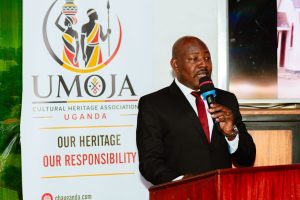
The afternoon session was moderated by Dr. Ochieng Amos, who also serves as Chairperson of Umoja Cultural and Heritage Association Uganda (CHAU).
The session examined “Built Heritage at the Crossroads: Governance, Risk and Resilience in Uganda’s Changing Cities.”
Key discussion areas included:
Legal and institutional frameworks for heritage protection
Urban planning laws and building codes
Community participation in urban heritage governance
The future of historic buildings and their owners
Panelists included:
- Nampedho
- John Dconanck
- Matua Christine
Heritage Preservation Beyond Symbolism
One of the strongest messages emerging from the conference was the need to move heritage preservation beyond symbolic discussions and integrate it into practical urban planning systems.
Participants emphasized that Uganda’s towns and cities are expanding at unprecedented rates, making it increasingly important to incorporate heritage conservation into development policies and planning frameworks.
Among the anticipated outcomes of the conference were:
Policy recommendations for integrating heritage conservation into urban planning systems
Development of a national position statement on architectural heritage conservation
Strengthened collaboration among government agencies, cultural institutions, and development partners
Participants also agreed that Uganda’s urban heritage should not be viewed as static relics of the past, but as living assets capable of supporting sustainable tourism, education, community pride, and long-term development.
What Lays Ahead of Us!
As Uganda continues to urbanize, the challenge remains clear: preserving the nation’s cultural identity while embracing modern growth. The 3rd National Cultural Heritage Conference 2026 served as a timely reminder that development should not come at the cost of history.
By protecting architectural heritage today, Uganda can ensure that future generations inherit cities that reflect the country’s rich cultural story, resilience, and identity.